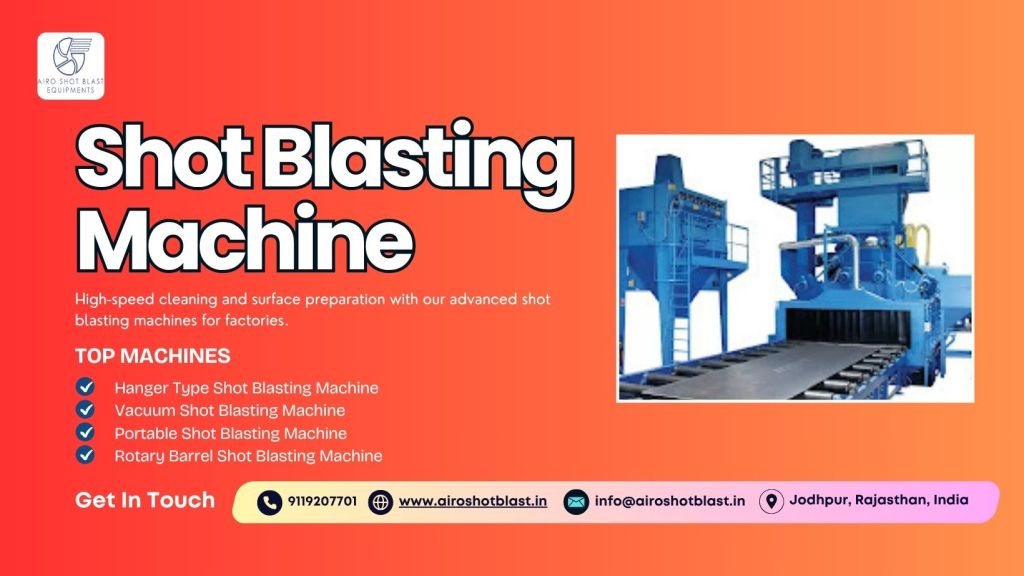
Two fabrication shops sit less than five miles apart in the same industrial park. They target the same customers, bid on the same projects, and employ similarly skilled workers. One consistently wins contracts at healthy margins while the other struggles to compete on anything except price. The difference? The successful shop invested in modern shot blasting technology three years ago. The struggling one is still outsourcing surface prep or using 20-year-old equipment that barely functions.
This isn’t a story about equipment—it’s a story about competitive positioning. In manufacturing, the technology you deploy directly determines your ability to compete, and shot blasting is no exception. Let’s talk about how this particular technology creates or destroys competitive advantage in ways most business owners don’t fully appreciate.
Speed to Market Creates Opportunity
When a customer calls with an urgent project, can you handle the entire job in-house from start to finish, or do you need to coordinate with outside vendors for blasting and coating prep?
The shop with modern, efficient shot blasting capacity can quote a one-week turnaround with confidence. The shop without it needs to add coordination time, shipping time to the blaster, waiting in someone else’s queue, return shipping, and then coating. Suddenly that one-week job becomes three weeks.
In competitive markets, speed wins contracts. Being able to respond quickly to urgent needs or short-deadline opportunities means you’re capturing work that competitors simply can’t accommodate. That creates pricing power—customers pay premiums for fast, reliable turnaround.
I watched this play out with a structural steel fabricator. They installed an automated shot blasting line and suddenly could promise same-week delivery on standard products. Competitors were quoting 3-4 weeks for identical items. The fabricator didn’t even need to lower prices—they won on speed alone and actually improved margins because customers valued the quick turnaround.
Speed isn’t just about winning bids. It’s about cash flow velocity. Faster project completion means faster invoicing, faster payment, and better working capital management. Your money isn’t tied up in work-in-progress for extended periods.
Quality Consistency Builds Reputation
Customers notice when every part looks identical and performs the same way. They especially notice when coating failures happen—or don’t happen.
Modern shot blasting equipment with proper controls delivers remarkably consistent surface preparation. Every part gets the same blast intensity, the same coverage, the same profile depth. This consistency translates directly to coating performance, which translates to customer satisfaction and repeat business.
Contrast this with outsourced blasting where you’re at the mercy of someone else’s quality control. Or with manual surface prep methods that vary based on operator skill and fatigue. The inconsistency creates quality problems that damage your reputation.
A powder coating operation I know tracked warranty claims before and after installing in-house shot blasting. Before: about 3% of jobs had some coating adhesion failure within the first year. After: less than 0.5%. That difference is measurable competitive advantage—fewer callbacks, lower warranty costs, happier customers, and stronger reputation.
Quality consistency also enables you to pursue higher-value work. Industries with strict surface preparation requirements—aerospace, medical devices, high-performance industrial equipment—won’t even consider vendors who can’t demonstrate consistent, documented surface prep capabilities. The right equipment opens doors to markets you couldn’t access otherwise.
Cost Structure Determines Pricing Flexibility
If you’re outsourcing blasting at ₹5-40 per Kg, that cost is baked into every quote. When a customer pushes for better pricing, you’ve got limited room to negotiate because a big chunk of your cost is fixed.
Bring that work in-house with efficient equipment, and your marginal cost might drop to ₹0.50-5.00 per Kg. Suddenly you have pricing flexibility. You can be competitive on price-sensitive bids without sacrificing margin. You can offer volume discounts that competitors can’t match. You can absorb cost increases elsewhere in your operation without raising prices.
This flexibility is pure competitive advantage. You’re not forced to be the high-price provider, but you’re also not trapped in race-to-the-bottom pricing because your cost structure supports healthy margins even at competitive price points.
See more – https://amarsingh.alboompro.com/post/shot-blasting-machine-applications-in-transformer-manufacturing
One job shop owner explained it perfectly: “Before we had our blast system, every bid felt like we were guessing what our real costs would be because so much depended on what the outside blaster charged. Now I know my exact costs, I can price accurately, and I win more bids because customers trust my numbers.”
Capacity Control Equals Scheduling Power
Nothing’s more frustrating than having your production schedule held hostage by an external vendor’s availability. You’ve got work ready to blast, but your go-to blasting service is backed up for two weeks. Your customer doesn’t care—they want their parts on time.
Owning your blasting capacity means controlling your own schedule. You blast when you need to, not when someone else can fit you in. This control eliminates a major source of uncertainty and enables you to make reliable delivery commitments.
It also creates opportunity during demand spikes. When your industry gets busy and everyone’s scrambling for blasting capacity, competitors are stuck waiting while you’re producing. You capture market share during the exact moments when customers are most frustrated with your competitors’ delays.
The inverse is equally important. During slower periods, you’re not paying someone else’s overhead. You can scale your internal blasting operation to match actual demand without being locked into service agreements or minimum charges.
Technology Signals Capability and Seriousness
Customer perception matters. When prospects tour your facility and see modern, well-maintained shot blasting equipment, they draw conclusions about your overall operation.
They conclude you’re serious about quality. That you invest in your capabilities. That you’re positioned for the long term, not just scraping by. These perceptions influence buying decisions, especially for larger contracts or long-term partnerships.
Conversely, if you’re running ancient, barely-functional equipment or clearly relying on outsourced processes for critical operations, customers question your stability and capability. They wonder if you can handle scaling up if their volumes increase. They worry about your long-term viability.
This isn’t superficial—customers make rational risk assessments based on visible indicators of operational capability. Modern equipment is one of those indicators.
Innovation Access Creates Differentiation
Shot blasting technology continues evolving. Modern machines offer capabilities that weren’t possible even a decade ago—precision media control, automated quality monitoring, integration with manufacturing execution systems, energy efficiency, and environmental compliance features.
Companies running cutting-edge equipment can offer services and guarantees that competitors using older technology simply can’t match. Maybe it’s documented surface profile measurement on every part. Maybe it’s integration with customer quality systems. Maybe it’s environmental certifications that certain customers require.
Each of these capabilities creates differentiation in the marketplace. You’re not just another fabricator offering blasting—you’re offering measurably superior results with documentation and consistency that competitors can’t duplicate.
The Competitive Moat Question
Here’s the strategic question: Does your shot blasting capability create a competitive moat, or are you just keeping pace?
If everyone in your market has similar equipment and capabilities, shot blasting is table stakes—necessary to compete but not sufficient to win. But if you’ve invested in superior technology while competitors haven’t, you’ve created separation.
That separation compounds over time. Better equipment enables better quality, which builds reputation, which commands premium pricing, which funds further investment, which widens the gap. It’s a virtuous cycle that’s difficult for competitors to break into.
The shops struggling to compete are usually the ones who deferred equipment investment, let their capabilities stagnate, and woke up one day to find they’re no longer competitive on anything except low-price commodity work.
Read More – https://www.linkedin.com/pulse/shot-blasting-machine-performance-validation-methods-amar-singh-dkchc
Making Technology Work For Competition
Shot blasting technology impacts competitiveness across multiple dimensions—speed, quality, cost, control, perception, and differentiation. But equipment alone doesn’t create advantage. How you deploy it, integrate it into your operations, and leverage it in the market determines whether it’s truly competitive advantage or just expensive overhead.
The shops winning in competitive markets aren’t necessarily the ones with the fanciest equipment. They’re the ones who made smart technology investments aligned with their market strategy and then executed relentlessly to extract maximum value.
Technology creates possibility. Execution creates advantage. The combination creates companies that don’t just survive competition—they define it.


Leave a Reply