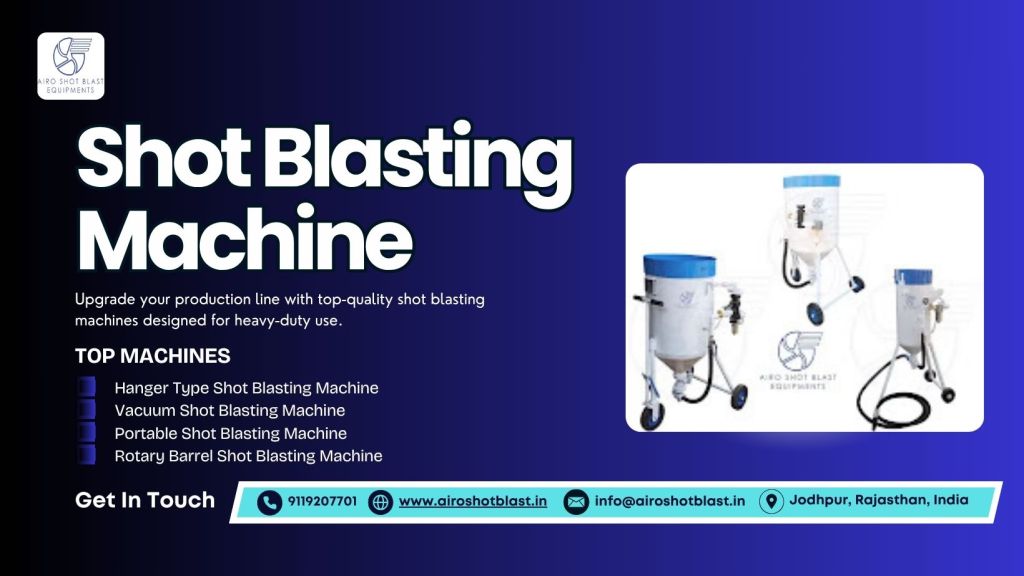
Buying a shot blasting machine for your workshop isn’t like picking up a new angle grinder. Get the grinder wrong, you’re out a hundred bucks. Get the shot blaster wrong, and you’re stuck with a piece of equipment that either gathers dust because it’s overkill or becomes a bottleneck because it can’t keep up.
I’ve walked through this decision process with dozens of workshop owners over the years, and the mistakes are remarkably consistent. People either buy based on price alone, or they go with whatever their competitor down the street has, or—and this is my personal favorite—they fall in love with features they’ll never actually use.
Let me walk you through how to actually make this decision, based on your real needs rather than the brochure specs.
Start With Your Actual Parts, Not Your Dreams
Every workshop owner I meet has big plans. “We’re going to expand into structural steel.” “We’re adding a powder coating line.” “Next year we’ll be doing twice the volume.”
That’s great. Dream big. But don’t spec your shot blasting machine based on what you hope to be doing in three years. Base it on what you’re actually doing right now, with maybe 25-30% growth factored in.
Here’s what you need to know about your current work:
Part size range – What’s the largest part you handle regularly? Not the one huge part you did six months ago, but the parts that come through weekly. If you’re mostly doing components that fit in a 2×2 foot area, don’t buy a machine with a 6×8 foot chamber. You’ll never fill it efficiently, and you’re paying for capacity you don’t need.
Part weight – Heavier parts need sturdier construction and more robust handling systems. If you’re blasting castings that weigh 200 pounds each, a lightweight tumble-blast machine designed for small components isn’t going to cut it.
Material types – Are you blasting steel, aluminum, stainless, or a mix? Different materials respond differently to blasting. Aluminum needs gentler treatment than heavy structural steel. Make sure your machine can handle your actual material mix.
Surface finish requirements – Are you prepping for powder coating? Removing heavy mill scale? Light deburring? The finish quality you need determines everything from blast wheel configuration to media selection to chamber design.
A fabrication shop I worked with bought a massive cabinet-style machine because they got a good deal. Problem? Most of their work was small brackets and plates. They were loading maybe 10% of the cabinet capacity per cycle, which meant terrible efficiency. They eventually sold it at a loss and bought something appropriately sized. Learn from their mistake.
Production Volume: Be Honest With Yourself
How many parts do you actually need to blast per day or per week? Not during your busiest month last year, but on average.
If you’re running 20-30 parts per day, a manual cabinet machine might be perfect. You can load, blast, unload, move on. Total cycle time including handling is maybe 5-10 minutes per part. That’s 2-3 hours of actual blasting work per day, which leaves plenty of time for other tasks.
Push that to 100+ parts per day, and you need something more automated. Maybe a tumble-blast system for small parts, or a conveyor-fed cabinet for continuous processing. The labor cost of manually handling that many parts becomes prohibitive.
Here’s a rough framework from my experience:
- Under 25 parts/day – Manual cabinet is usually sufficient
- 25-75 parts/day – Semi-automatic or batch systems make sense
- 75-200 parts/day – You want automated loading/unloading or continuous systems
- 200+ parts/day – Full production equipment with conveyors and multi-wheel configurations.
Also Check – Shot Blasting Machine Manufacturers, Shot Blasting Machine Manufacturers in India, Shot Blasting Machine Price, Shot Blasting Machine Price in India, Abrasive Shot Blasting Machine
But volume alone doesn’t tell the whole story. Part complexity matters too. Complex parts with multiple surfaces might take longer per piece even in an automated system.
Space: The Constraint Nobody Thinks About Until It’s Too Late
Measure your available floor space. Measure it again. Now subtract 30% for access, maintenance, media storage, and dust collection equipment.
That’s your actual usable space.
Shot blasting machines take up more room than you think. The chamber itself is just the beginning. You also need:
- Dust collector (these can be huge)
- Media storage hopper
- Access space for loading/unloading
- Maintenance clearance around the machine
- Electrical panel location
- Operator work area
I visited a workshop last year where they’d bought a great machine at a fantastic price. It sat in their receiving area for two months because once they actually measured everything, it wouldn’t fit in the space they’d allocated. They ended up renting additional space in an adjacent building just to house it. That “great deal” turned expensive real quick.
Draw it out. Use tape on the floor if you need to. Include everything, not just the machine footprint.
At Airo Shot Blast Equipments, we’ve helped plenty of customers with facility layout planning before they commit to a purchase. It’s way easier to solve space issues on paper than after delivery.
Media Selection: Working Backwards From Finish Quality
Don’t choose your machine first and then figure out what media to run. Work backwards from your required finish.
Different machines handle different media types with varying degrees of effectiveness. Some are specifically designed for steel shot. Others can handle a range of media including grit, glass bead, or ceramic. The more flexible the media options, the more you pay upfront, but you gain versatility.
For most workshop applications dealing with steel fabrication, standard steel shot or steel grit works fine. If you’re doing aluminum, stainless, or specialty materials, you’ll want a machine that can handle gentler media like glass bead or aluminum oxide.
Also consider media cost and availability. There’s no point having a machine that runs on exotic specialty media if you can’t source it reliably or if it costs three times what standard media costs.
Ask potential suppliers: “What media does this machine run optimally?” Not “what media can it run,” but what it runs well. There’s a difference.
Cabinet vs. Tumble-Blast vs. Continuous: Matching Machine Type to Work
Cabinet machines are the workhorses for job shops and small to medium fabricators. You load parts, close the door, blast, done. They’re versatile, handle varying part sizes and shapes, and give you good control over the process.
Best for: Varied work, medium-sized parts, batch processing, job shop environments
Tumble-blast machines are great for small parts that can handle being tumbled together. Bolts, nuts, small castings, brackets—throw them in, the machine tumbles them through the blast stream, and they come out uniformly cleaned.
Best for: High volumes of small similar parts, foundries, fastener processing
Continuous systems (roller conveyor, belt conveyor, spinner hanger) are production machines. Parts move through continuously, which maximizes throughput but requires fairly consistent part sizing and shape.
Best for: High-volume production, consistent part types, automated production lines
Table machines have a rotating table that spins parts through the blast pattern. Good for parts with complex geometries that need all-around coverage.
Best for: Complex shapes, medium production volumes, parts needing uniform 360-degree blasting
Website –
- https://www.airoshotblast.in/,
- https://www.shotblastingmachines.in/shot-blasting-machine,
- https://www.sandblastingmachine.in/shot-blasting-machine/shot-blasting-machine,
- https://www.sandblast.in/product/shot-blasting-machine-manufacturers,
- https://www.shotblast.in/,
- https://shotsblastingmachine.com/
Most workshops start with a cabinet machine because it offers the most flexibility. You can always add specialized equipment later as volumes justify it.
Blast Wheel Configuration: More Isn’t Always Better
Blast wheels are expensive. Machines with multiple wheels cost more upfront and more to maintain. Don’t buy more wheels than you actually need.
A single-wheel machine can do excellent work on many applications. You just might need to reposition parts or run multiple cycles for complex geometries. If that’s only occasional, it’s cheaper than buying and maintaining extra wheels.
Multiple wheels make sense when:
- You need simultaneous coverage of multiple surfaces
- Production volume justifies the faster cycle times
- Parts are large enough to benefit from multi-directional blasting
- You’re running continuous production where speed matters
A two-wheel machine oriented at different angles can cover most complex parts in a single cycle. Four or six wheel machines are really for high-production environments where every second of cycle time matters.
Be realistic about your actual needs. That extra wheel looks impressive in the demo, but if you’re not using it, you’re just paying to maintain it.
Power Requirements and Operating Costs
Check your facility’s electrical service before you fall in love with a machine. A big shot blaster can draw 75-100 amps at 480V three-phase. If you don’t have adequate electrical service, you’re looking at thousands of dollars in upgrades before you can even plug it in.
Get the amp draw and voltage requirements from the manufacturer. Have an electrician verify your facility can handle it. Factor in the cost of any necessary electrical upgrades.
Also consider compressed air requirements if the machine uses pneumatic controls or air-operated components. Do you have adequate CFM capacity? What’s the pressure requirement?
Operating costs beyond electricity:
- Abrasive Media consumption (ongoing)
- Wear parts (blast wheels, liners, seals)
- Dust collector filters
- Maintenance labor
A machine with great energy efficiency might cost INR 50,000 more upfront but save INR 10,500 annually in electricity. That’s a three-year payback, and the machine will likely run 15-20 years.
Dust Collection: Non-Negotiable
If anyone tries to sell you a shot blasting machine without adequate dust collection, walk away. Proper dust collection isn’t optional—it’s essential for safety, visibility, environmental compliance, and machine longevity.
Most quality machines include an integrated or matched dust collector. Verify:
- Filter area (adequate for the blast volume)
- CFM rating (matches the machine requirements)
- Filter cleaning mechanism (pulse-jet is standard)
- Disposal method for collected dust
Undersized dust collectors create visibility problems, health hazards, and maintenance headaches. You’ll be replacing filters constantly, your machine will clog with dust, and you’ll be out of compliance with air quality regulations.
This is one area where you don’t want to cheap out. Buy the dust collector the manufacturer recommends, not the minimum they say might work.
Automation Level: What Actually Saves Money
Automation sounds great until you realize you’re spending 20 minutes programming the system for a batch of ten parts.
Basic manual machines require operator presence for loading, blasting, and unloading. Simple, reliable, affordable. Great for varied work and lower volumes.
Semi-automatic systems might auto-cycle the blast process but still need manual loading/unloading. This is often the sweet spot for workshops—you get consistent blast cycles without the complexity and cost of full automation.
Full automation with robotic loading, indexing, and unloading makes sense only at high volumes with consistent parts. The complexity, cost, and programming requirements aren’t justified for typical workshop environments.
Think about your labor costs and production volume. If automation saves you one hour of labor per day at INR 100/hour, that’s about INR 96,000 annually. How much extra does the automation cost? If it’s INR 500,000, that’s a five-year payback. Is that worth it for your situation?
Maintenance Accessibility: Future You Will Thank You
When you’re evaluating machines, physically look at how you’d perform routine maintenance:
Can you easily access the blast wheels for inspection and blade changes? Or do you need to disassemble half the machine?
Are wear parts readily accessible? Door seals, liners, separator screens—can you replace them without special tools or acrobatic skills?
How easy is it to clean out media buildup or clear jams?
Machines that are designed for easy maintenance cost slightly more but save you hours of frustration over their lifetime. When you’re comparing options, imagine yourself doing a blast wheel blade change on each machine. Which one makes you groan just thinking about it?
Brand Reputation and Support
This matters more than most people realize. A shot blasting machine isn’t something you’ll replace in a couple years. You’re looking at 10-20 years of service life.
What happens when you need:
- Technical support for troubleshooting
- Replacement wear parts
- Emergency repairs
- System upgrades
Companies like Airo Shot Blast Equipments have built their reputation on post-sale support and parts availability. We’ve seen competitors come and go, but the companies that support their equipment long-term are the ones still around.
Ask potential suppliers:
- What’s your parts availability and lead time?
- Do you stock common wear items locally?
- What’s your response time for technical support?
- Can you provide customer references?
Actually call those references. Ask about their experience after the sale, not just during it.
Making the Final Decision
Once you’ve narrowed down your options based on all the factors above, here’s my recommendation: run test parts if at all possible.
Most reputable manufacturers will blast sample parts on the machine model you’re considering. This tells you:
- Actual cycle times with your parts
- Surface finish quality on your materials
- How easy loading and unloading actually is
- Whether the machine genuinely fits your application
If a supplier won’t run samples, that’s a red flag.
Also, visit an existing installation if you can. See the machine operating in a real production environment, talk to the operator, and ask about the ownership experience.
The Bottom Line
Choosing the best shot blasting machine isn’t about finding the cheapest option or the one with the most impressive specs. It’s about matching equipment capabilities to your actual needs—current and reasonably projected future needs.
Take the time to honestly assess your part sizes, production volumes, finish requirements, and budget. Don’t get talked into features you don’t need, but don’t skimp on essentials like adequate capacity, proper dust collection, and reliable support.
The right machine becomes a cornerstone of your operation. It processes parts consistently, requires reasonable maintenance, and delivers the surface quality your downstream processes need.
The wrong machine becomes an expensive lesson in the importance of doing your homework.
Choose wisely, and that machine will still be running strong when you’re thinking about retiring.


Leave a Reply