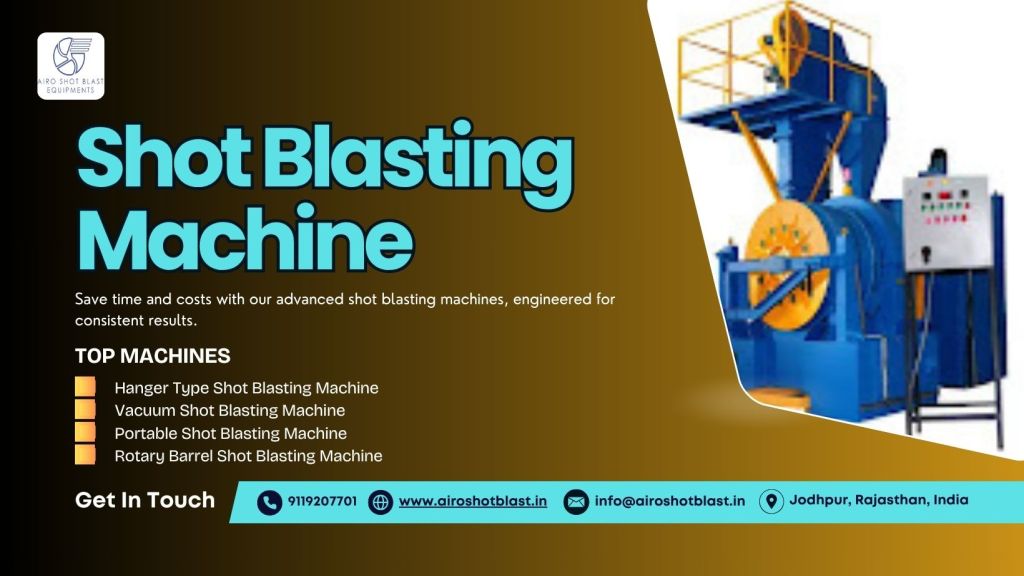
I’ll never forget the first time I saw what a properly configured shot blasting machine could do to a piece of rusted structural steel. One side looked like it had been pulled from a scrapyard circa 1987—pitted, scaled, corroded beyond recognition. The other side, fresh from the blast chamber, looked almost new. Same piece of metal, but the blasted side had that distinctive bright, uniform gray finish that practically screams “ready for coating.”
That’s when it clicked for me. Shot blasting isn’t just about making metal look prettier. It’s about fundamentally transforming the surface in ways that affect everything downstream—coating life, weld quality, corrosion resistance, the works.
So let’s talk about the specific ways these machines actually improve metal surfaces, beyond just “it cleans stuff.”
1. Creating Anchor Patterns That Coatings Actually Stick To
You can have the best powder coating or paint system in the world, but if your surface prep is garbage, your coating is coming off. Maybe not today, maybe not next month, but it’s coming off.
Shot blasting creates an anchor pattern—basically a controlled roughness profile—that gives coatings something to grip. Think of it like the difference between trying to climb a glass wall versus a rock climbing wall. One’s impossible, the other has handholds everywhere.
When steel shot impacts metal at high velocity, it creates tiny peaks and valleys across the entire surface. These microscopic indentations dramatically increase the actual surface area available for coating adhesion. A surface that looks smooth to your eye might have 40-60% more actual surface area after shot blasting when you measure it at the microscopic level.
The beauty of shot blasting versus hand tools or chemical cleaning is consistency. Every square inch gets the same treatment, the same impact energy, the same anchor pattern. I’ve measured surface profiles on parts coming out of a well-maintained blast machine, and the variation is minimal—maybe 0.5 mils difference across the entire part.
Try achieving that with a wire brush or a DA sander. You’ll get variation based on operator pressure, tool speed, fatigue level, and whether they had enough coffee that morning. Shot blasting doesn’t get tired or distracted.
2. Removing Contaminants You Can’t Even See
Mill scale is the obvious target. That blue-black oxide layer that forms on hot-rolled steel looks almost protective, but it’s actually a ticking time bomb under your coating. Mill scale is brittle and has a different expansion rate than the base metal. It cracks, moisture gets underneath, and you’ve got corrosion happening under what looks like a perfectly good coating.
Chemical pickling can remove mill scale, but it’s messy, slow, and you’re dealing with hazardous waste. Shot blasting physically tears it off along with everything else that doesn’t belong there—rust, old coatings, oil residues, welding spatter, you name it.
But here’s what most people don’t appreciate: shot blasting also removes embedded contaminants. Grease that’s soaked into the surface porosity. Carbon deposits from cutting or welding. Invisible films of oxidation that form during storage. Your eyes might say “that looks clean,” but a properly shot-blasted surface is clean at a molecular level.
I worked with a shop doing precision hydraulic components. They were having random coating failures—maybe 2-3% of parts. Switched from chemical cleaning to shot blasting, and failures dropped to essentially zero. Turned out they had trace cutting fluid contamination that chemical cleaning wasn’t fully removing. Shot blasting doesn’t leave anything behind.
3. Stress Relieving and Surface Hardening Through Peening
This one surprises people. Shot blasting isn’t just subtractive—it’s also transformative.
When round steel shot impacts a metal surface, it doesn’t just remove material. It also creates compressive stress in the surface layer. This is called shot peening when done intentionally, but even regular shot blasting with round media produces some peening effect.
Why does this matter? Compressive stress opposes crack formation and propagation. Most fatigue failures start with surface cracks that grow under tensile stress. By creating a compressive stress layer, shot blasting actually makes the surface more resistant to fatigue cracking.
This isn’t theoretical. The aerospace industry has been using shot peening for decades to extend the life of critical components—landing gear, turbine blades, structural components. The same physics applies when you’re shot blasting parts, just to a lesser degree.
I’ve seen test data on shot-blasted vs. non-blasted steel samples subjected to cyclic loading. The blasted samples consistently showed 20-30% improvement in fatigue life. That’s huge for applications involving vibration, stress cycling, or dynamic loads.
Plus, the peening action work-hardens the surface layer slightly. You’re deforming the metal microstructure, which increases surface hardness without affecting the core properties. For wear applications, this can extend service life noticeably.
4. Revealing Defects Before They Become Failures
A smooth, painted surface can hide a multitude of sins. Cracks, porosity, inclusions, laminations—they’re all lurking under there waiting to cause problems.
Shot blasting strips everything down to bare metal and creates a uniform matte finish. Defects become obvious. That little crack in a weld that you couldn’t see through mill scale? After blasting, it’s right there, clear as day. Porosity in a casting? The blasted surface will show it as small pits or voids.
Quality control inspection is infinitely easier on a shot-blasted surface. Dye penetrant testing, magnetic particle inspection, visual inspection—they all work better when you’re looking at clean, uniformly textured metal rather than a variable surface with contaminants and scale.
I remember a fabricator who was having warranty issues with welded assemblies. Welds looked fine through inspection. Parts got powder coated, shipped out, and then started cracking in service. Finally, someone suggested blasting parts before coating. Started finding small heat-affected zone cracks that were invisible under mill scale. Problem solved—they were able to catch and repair defects before coating instead of after failure.
The cost of finding a defect at the blasting stage versus after it fails in the field? Not even in the same universe.
5. Creating Optimal Surface Roughness for Specific Applications
Not all surface finishes are created equal, and shot blasting gives you control over the final texture in ways other methods can’t match.
Need a relatively smooth surface for tight-tolerance assembly? Blast with fine steel shot at moderate velocity. Want an aggressive profile for heavy-duty industrial coatings? Switch to coarse angular grit at high intensity. The combination of media type, size, and blast intensity gives you a wide range of achievable surface profiles.
This matters more than most people realize. Powder coating specifications typically call for a surface profile between 1-3 mils. Too smooth, and the coating won’t anchor properly. Too rough, and you get peaks poking through the coating layer, creating early failure points.
High-performance industrial coatings—epoxies, polyurethanes, zinc-rich primers—each have optimal surface profile ranges. Shot blasting lets you dial in exactly what you need.
I’ve also seen shops use different blast media for different aesthetic effects. Fine glass bead creates a satin finish that’s popular for architectural metal. Steel grit gives a more aggressive, textured appearance. You’re not just cleaning the surface—you’re also determining its final appearance and texture.
6. Improving Weld Quality and Preparation
If you’re welding over mill scale, slag, rust, or contamination, you’re creating porosity, inclusions, and weak welds. The heat doesn’t properly penetrate the contaminants, you get incomplete fusion, and your weld quality suffers.
Shot blasting before welding removes all that junk and gives you clean base metal. The result is better arc stability, improved penetration, and cleaner welds with fewer defects.
But here’s the part that doesn’t get enough attention: shot blasting after welding is equally important. The heat-affected zone around welds creates oxide layers and scale that need removal before coating. Grinding is one option, but it’s slow and creates inconsistent surface profiles. Shot blasting treats the weld zone and the base metal identically, giving you a uniform surface ready for coating.
Some fabricators blast, weld, then blast again. The first blast prepares for welding. The second blast prepares for coating. Yes, it’s an extra step, but the improvement in final quality is measurable.
A structural steel fabricator I know started doing this two-stage blasting on critical connections. Their ultrasonic weld inspection pass rate went from maybe 85% to over 98%. The blasting cost was trivial compared to the cost of weld repair and re-inspection.
7. Extending the Life of the Finished Product
Everything we’ve talked about ultimately leads to this: parts that last longer.
Better coating adhesion means coatings stay in place. Coatings that stay in place mean the base metal stays protected from corrosion. Surfaces free of stress concentrations resist fatigue cracking. Defect-free surfaces don’t become failure initiation points.
I’ve seen side-by-side comparisons of identical parts, some shot-blasted before coating and some prepared by other methods. The blasted parts consistently outlast the others in corrosion exposure testing, salt spray testing, and field service.
There’s a reason the steel bridge industry specifies shot blasting for surface prep. They need those bridges to last 50-100 years, and proper surface preparation is the foundation of that longevity. The International Paint System requires near-white metal blast cleaning (Sa 2.5 or better) for good reason—it works.
In automotive, shot blasting is standard for chassis components, suspension parts, anything that faces road salt and weather exposure. The peening effect adds fatigue resistance, the clean surface ensures coating adhesion, and the result is parts that survive years of abuse.
Even in less demanding applications, the difference shows up. Industrial equipment, agricultural machinery, outdoor furniture—anything exposed to weather performs better and lasts longer with proper shot-blasted surface preparation.
The Real Value Proposition
Here’s what it comes down to: shot blasting is an investment in everything that happens afterward.
You pay for it once, upfront, during manufacturing. But that investment pays dividends throughout the product’s entire service life. Fewer warranty claims. Less frequent maintenance. Longer replacement cycles. Better customer satisfaction.
I’ve watched companies try to save money by skipping shot blasting or using cheaper surface prep methods. And I’ve watched them spend multiples of that “savings” dealing with premature failures, warranty work, and damaged reputations.
The metal surface quality you get from shot blasting isn’t just about aesthetics or meeting spec requirements. It’s about building products that perform the way they’re supposed to, for as long as they’re supposed to, without surprises.
And in manufacturing, eliminating surprises is worth its weight in gold—or in this case, steel shot.
Related Post – https://site-eaihnws1z.godaddysites.com/f/shot-blasting-with-complete-installation-support-by-airo-shot



 Airo Shot Blast Equipments
Leave a comment