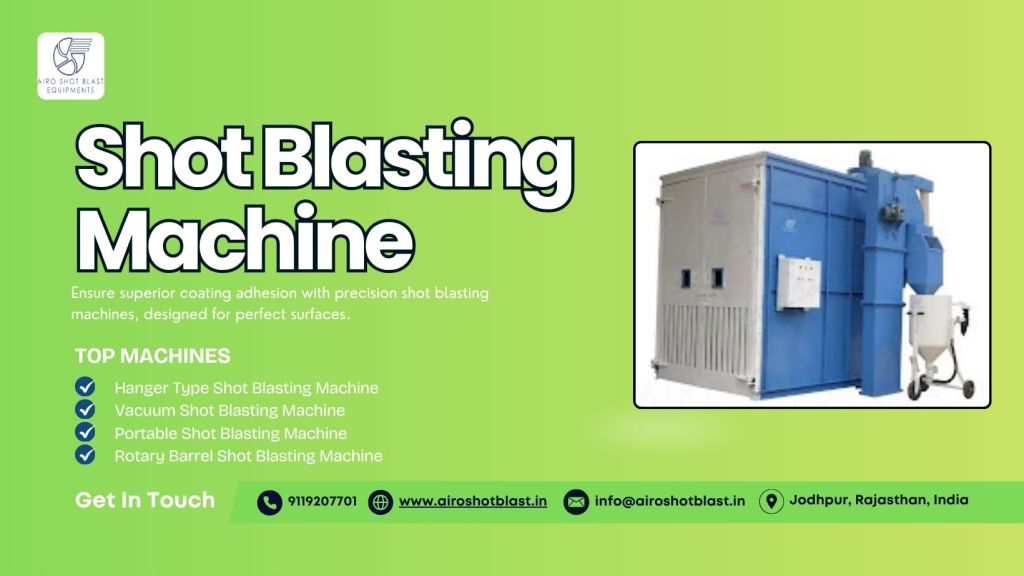
In today’s competitive manufacturing landscape, surface preparation plays a decisive role in determining product quality and durability. Shot blasting machines have become an essential solution for industries aiming to achieve clean, uniform, and high-performance surfaces. Among the various technologies available, wheel blasting and air blasting systems stand out as the most widely used methods. Each offers distinct operational advantages, making it important for manufacturers to understand their differences before making an investment.
Shot blasting is not just about cleaning metal surfaces—it directly impacts coating adhesion, fatigue strength, and overall product lifespan. As industries continue to demand faster production cycles and higher quality standards, choosing the right blasting system becomes a strategic decision.
What Are Wheel Shot Blasting Systems?
Wheel blasting systems use a high-speed rotating wheel to propel abrasive media onto the surface. This method relies on centrifugal force rather than compressed air, making it highly efficient for large-scale industrial operations.
How Wheel Blasting Works
In a wheel blasting machine, abrasive media such as steel shots or grit is fed into a spinning blast wheel. The wheel accelerates the media and throws it onto the target surface at high velocity. This impact removes rust, scale, and contaminants while creating a uniform surface profile.
This process is continuous and automated, which allows manufacturers to handle large volumes of components without compromising consistency.
Key Advantages of Wheel Systems
Wheel blasting systems are known for their productivity and cost-effectiveness. Since they do not rely on compressed air, they consume less energy and require lower operational costs over time. These machines are ideal for repetitive tasks, such as cleaning castings, structural steel, and automotive parts.
Another major advantage is their ability to recycle abrasive media efficiently. The enclosed system collects, cleans, and reuses the media, reducing waste and improving sustainability.
What Are Air Shot Blasting Systems?
Air blasting systems, also known as pneumatic blasting systems, use compressed air to propel abrasive media through a nozzle. This method offers greater flexibility and precision compared to wheel blasting.
Working Principle of Air Blasting
In an air blasting system, compressed air is used to push abrasive particles through a blasting nozzle. The operator or automated system directs the nozzle toward specific areas of the component, allowing for targeted cleaning and finishing.
This approach is particularly useful for intricate parts, delicate surfaces, or areas that require controlled blasting intensity.
Key Advantages of Air Systems
Air blasting systems provide unmatched control and adaptability. Operators can adjust pressure, media flow, and nozzle direction to achieve the desired finish. This makes them suitable for applications where precision is critical, such as aerospace components or detailed fabrication work.
Additionally, air blasting machines can be used for both light cleaning and aggressive surface preparation, depending on the settings and abrasive type.
Wheel vs. Air Systems: A Comparative Analysis
Understanding the differences between wheel and air operated blasting systems is essential for selecting the right solution.
Wheel blasting systems excel in high-volume production environments. They offer faster processing speeds, lower operational costs, and consistent results across large batches. These machines are commonly used in industries such as automotive manufacturing, foundries, and heavy fabrication.
On the other hand, air blasting systems are better suited for precision tasks. They allow operators to focus on specific areas, making them ideal for complex geometries and sensitive components. While they may have higher operating costs due to compressed air usage, their flexibility makes them indispensable in certain applications.
In simple terms, wheel blasting is about efficiency and scale, while air blasting focuses on precision and control.
Applications Across Industrial Sectors
Both wheel and air blasting systems are widely used across various industries, each serving unique purposes.
In the automotive sector, wheel blasting machines are commonly used to clean engine parts, gears, and structural components. Their ability to handle large volumes ensures consistent quality in mass production.
In aerospace and precision engineering, air blasting systems are preferred due to their ability to handle delicate components without causing damage. They are also used for surface finishing and coating preparation where accuracy is critical.
Construction and infrastructure projects benefit from both systems. Wheel blasting is used for structural steel cleaning, while air blasting is applied for on-site maintenance and touch-up work.
Choosing the Right Shot Blasting System
Selecting the right shot blasting machine depends on several factors, including production volume, component complexity, and budget.
Manufacturers handling large quantities of similar parts should consider wheel blasting systems for their speed and efficiency. These machines reduce cycle time and operational costs, making them a smart choice for high-output environments.
For businesses dealing with complex or delicate components, air blasting systems offer better control and versatility. They allow for precise surface treatment, ensuring that even the most intricate parts meet quality standards.
It is also important to evaluate long-term costs, maintenance requirements, and energy consumption before making a decision. Investing in the right system not only improves productivity but also enhances overall operational efficiency.
Conclusion
Shot blasting technology continues to evolve, offering advanced solutions for modern manufacturing challenges. Understanding the differences between wheel and air blasting systems is crucial for selecting the most suitable option for your operations.
Wheel blasting machines deliver speed, consistency, and cost efficiency, making them ideal for large-scale production. Air blasting systems, on the other hand, provide precision and flexibility, catering to specialized applications.
By carefully assessing your production needs and surface preparation requirements, you can choose a system that maximizes performance, reduces costs, and ensures superior results. In an industry where quality and efficiency are paramount, the right shot blasting solution can make all the difference.


Leave a Reply